If you’re commissioning a software project — whether that’s an internal tool, a customer-facing platform, or a mobile app — you’ll hear your development partner mention “the SDLC.” It’s not jargon for jargon’s sake. The software development life cycle is the structured process that turns a business idea into working software, and understanding it helps you ask the right questions, spot warning signs early, and set realistic expectations for timeline and cost.
Table of Contents
Here’s what it actually involves, and how it’s changing in 2026.
What Is the Software Development Life Cycle?
The SDLC is a defined sequence of stages a software project moves through, from initial idea to ongoing maintenance. It’s formalised by standards bodies, with NIST and ISO/IEC 12207 both defining a life cycle that teams adapt to Waterfall, Agile, or DevOps. The point isn’t bureaucracy — it’s predictability. Skipping phases might feel faster in the short term, but problems caught late in a project are far more expensive to fix than problems caught early.
If your project is a mobile app rather than a web platform, the same phases apply — see our guide on choosing the right development languages for mobile apps for how that decision fits into the design phase below.
The 7 Phases of the SDLC
| Phase | What Happens | Key Output |
| Planning | Define goals, scope, and budget | Project brief |
| Requirement analysis | Gather and document what the software must do | Requirements document |
| Design | Architecture, UI/UX, and technical decisions | System design |
| Implementation | Actual coding and build | Working software |
| Testing | Quality checks, bug fixing | Tested build |
| Deployment | Release to production/live environment | Live software |
| Maintenance | Ongoing updates, fixes, and monitoring | Stable, evolving product |
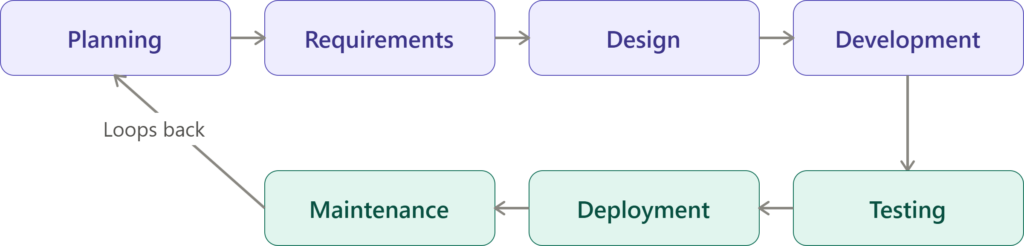
Maintenance feeds back into planning, which is why the software development life cycle is a cycle rather than a straight line. A well-run project doesn’t test everything at the end, modern teams build quality checks into every phase rather than treating testing as a single late-stage step.
SDLC Models: Waterfall, Agile, and DevOps
The 7 phases of the software development life cycle stay the same, what changes is how a team moves through them:
- Waterfall — each phase completes fully before the next begins. Predictable, but inflexible if requirements change mid-project.
- Agile — the same phases repeat in short cycles (sprints), with regular feedback and adjustment. The industry standard for most modern software projects.
- DevOps — extends Agile by tightly integrating development and deployment, enabling frequent, automated releases.
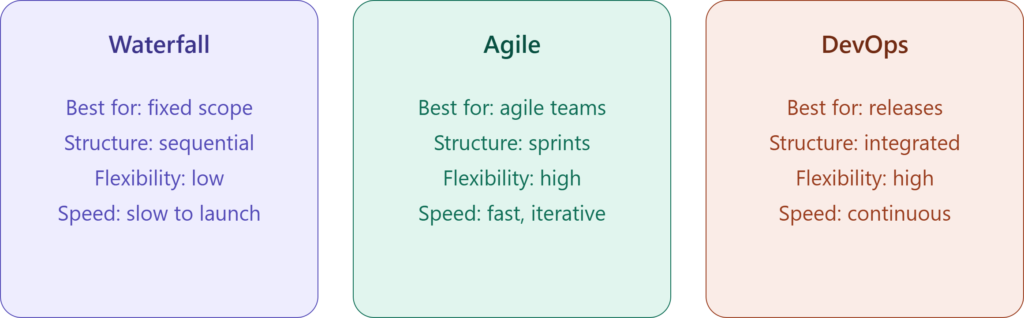
For most UK SMEs building a new product, Agile is the safer default — it lets you adjust direction as you learn what your users actually need, rather than locking in requirements 12 months before launch.
How AI Is Changing the SDLC in 2026
AI is no longer a side tool bolted onto development — it’s now embedded across the life cycle. A few shifts worth knowing about if you’re planning a software project this year:
- Planning and requirements — AI can now turn stakeholder interviews and support tickets into structured requirements documents, reducing the back-and-forth that used to cause scope creep.
- Testing — AI-driven testing tools can now handle the bulk of routine test cases, freeing human QA teams to focus on the edge cases that actually need judgment.
- Deployment and maintenance — predictive monitoring can now flag performance issues before they cause downtime, rather than after users notice.
Despite these advances, only 39% of IT leaders currently feel their development processes are agile enough to support business growth, according to Gartner — a reminder that adopting AI tools without adapting your underlying process doesn’t deliver the full benefit on its own.
If AI features (recommendations, automation, predictive insights) are part of what you’re building — not just how you’re building it — that’s a separate but related conversation. Our AI and automation team can help you scope that properly from the planning phase, rather than retrofitting it later.
Where Deployment and Maintenance Actually Live
Phases 6 and 7 — deployment and maintenance — are where a lot of UK startups underinvest. It’s tempting to treat “launch” as the finish line, but a live product needs reliable hosting, monitoring, and the ability to scale as usage grows. This is squarely a cloud infrastructure concern, and getting it wrong is one of the most common (and expensive) reasons software projects fail after a successful launch.
Why This Matters When Choosing a Development Partner
When you’re evaluating a software development agency, ask how they handle each phase — not just “can you build this app.” A partner who skips requirement analysis to start coding faster is optimising for a quick quote, not a working product. A structured software development life cycle process is what separates a custom software project that hits budget and works, from one that needs a rebuild six months after launch.
If you’re scoping a software project and want to see how a proper SDLC process would apply to your specific idea, our custom software development team can walk you through it before you commit to a build.