Choosing the right mobile app development languages for your project isn’t just a technical detail, it’s a decision that affects your budget, your time to market, and how easily your app can grow with your business. For UK founders and SMEs, getting this right early avoids expensive rebuilds later.
There’s no single “best” language. The right choice depends on your platform (iOS, Android, or both), your budget, your timeline, and whether AI features are part of your roadmap. Here’s how the main mobile app development languages compare in 2026.
Table of Contents
Native vs Cross-Platform vs Hybrid: The Core Decision
Before picking a specific language, decide on an approach:
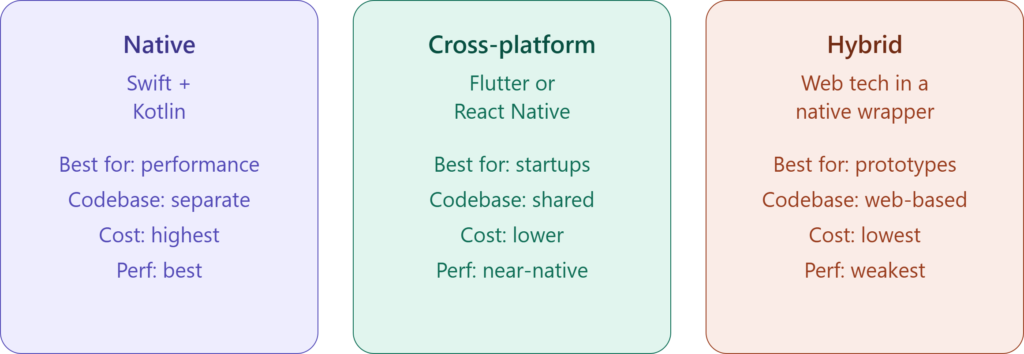
- Native — separate codebases for iOS (Swift) and Android (Kotlin). Best performance and platform integration, higher cost.
- Cross-platform — one codebase (Flutter or React Native) for both platforms. Faster and cheaper, with performance now close to native for most business apps.
- Hybrid — web technology wrapped in a native shell. Fastest to prototype, but weakest performance and user experience — best for internal tools, not customer-facing apps.
| Language / Framework | Best For | Platform | Typical Use Case |
| Swift | iOS-only apps | iOS, iPadOS, macOS | Apps for an Apple-first audience |
| Kotlin | Android-only apps | Android | Android-first or enterprise Android apps |
| Flutter (Dart) | Cross-platform, fast MVPs | iOS + Android + Web | Startups needing one codebase, fast launch |
| React Native | Cross-platform, JS teams | iOS + Android | Teams with existing web/JavaScript developers |
| Python | AI/backend features | Backend only | Apps needing AI, ML, or data-heavy features |
Building for iOS: Why Swift Still Leads
Swift remains Apple’s official language and the clear choice for any app built primarily for iPhone and iPad users. It’s fast, safe, and well-supported by Apple’s own tooling — ideal if your customers are predominantly on Apple devices, which is common across UK retail, hospitality, and professional services apps.
Building for Android: Kotlin’s Position
Kotlin is Google’s preferred language for Android and is the standard choice for Android-first or enterprise-grade apps. It works well alongside existing Java systems, which matters for UK businesses with older backend infrastructure they don’t want to rebuild from scratch.
Cross-Platform: Flutter vs React Native
Most UK startups and SMEs don’t need — or can’t justify the cost of — two separate native apps. This is where cross-platform frameworks come in:
- Flutter suits businesses that want a highly polished, consistent UI across iOS and Android from a single codebase, with strong AI library support built in.
- React Native suits teams that already have JavaScript or web developers, since it shares much of the same skill set and ecosystem.
Both are strong mobile app development languages choices that can cut cost and time significantly compared to building two native apps in parallel, an important factor for early-stage UK businesses managing tight budgets.
If you’re deciding between a fully custom native build and a faster cross-platform launch, this is exactly the kind of trade-off our web and mobile app development team helps clients work through before writing a single line of code.
Where AI Fits Into Your Language Choice
AI features, recommendations, chat assistants, predictive search, are increasingly expected in mobile apps, not optional extras. If AI is part of your product roadmap, your mobile app development languages choice matters as much on the backend as the frontend, Python remains the standard choice for AI and machine learning integration, working alongside whichever frontend language you choose for the app itself.
If you’re planning AI-powered features for your app, it’s worth scoping this early with our AI and automation team so the language and architecture decisions support it from day one, rather than retrofitting AI later.
Don’t Forget the Backend
The language on the screen is only half the picture. Every mobile app needs reliable backend infrastructure to handle data, user accounts, and scaling as your user base grows. This is where many UK startups underinvest early on, then hit performance problems at exactly the moment their app starts gaining traction.
Our cloud infrastructure services are built to make sure your app’s backend can scale with you, whether you’re on AWS or Microsoft Azure.
When You Need More Than “Just an App”
Sometimes the mobile app is only one piece of a larger system — connecting to internal dashboards, third-party APIs, or existing business software. In these cases, the language decision becomes part of a bigger custom software architecture, not a standalone app choice.
If your project looks more like a connected system than a single app, our custom software development team can help you plan the full architecture, not just the app layer.
How to Choose the Right Mobile App Development Languages
These are the key questions to ask when comparing mobile app development languages for your business.
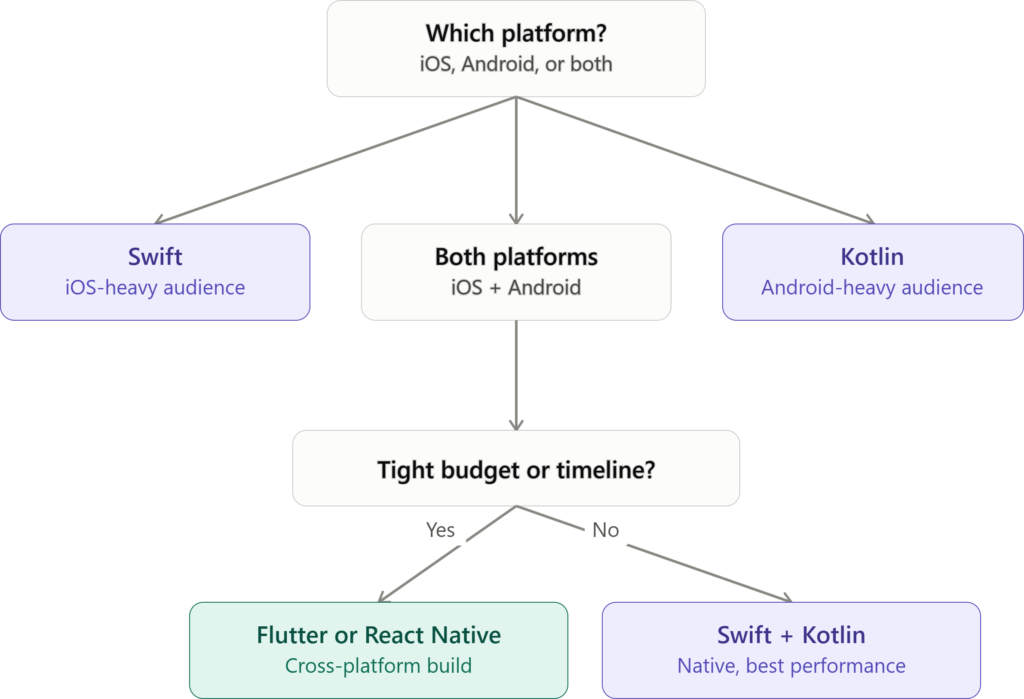
- Which platform do your customers actually use? iOS-heavy audience → lean native (Swift). Mixed or Android-heavy → consider Kotlin or cross-platform.
- What’s your budget and timeline? Tight budget or fast MVP → Flutter or React Native.
- Do you have existing developers or systems? Web/JS team → React Native. Existing Java systems → Kotlin.
- Is AI part of the roadmap? Plan your backend language (typically Python) alongside your frontend choice from the start.
- Will this app need to scale? Factor in cloud infrastructure costs and architecture from day one, not after launch.
Get It Right the First Time
The wrong mobile app development languages choice doesn’t just slow you down, it can mean rebuilding your app from scratch. If you’re planning a mobile app for your UK business and want an honest assessment of the right approach for your specific goals, get in touch with our team before you start development.