
Using AI in business development” means something different depending on who you ask — for some it’s a chatbot answering customer questions, for others it’s automating lead follow-up or drafting proposals. The confusion isn’t your fault; the term gets used loosely. Here’s what it actually looks like in practice, and where UK businesses are seeing real returns versus where caution is still warranted.
Table of Contents
What AI for Business Development Actually Covers
Business development spans everything that grows your business — finding leads, converting them, retaining customers, and running operations efficiently. AI now touches most of these areas, but not all applications are equally mature or equally safe to hand over.
| Business Area | Common AI Use Case | Maturity in 2026 |
| Customer service | Chatbots, WhatsApp automation, ticket triage | High — widely adopted, fast ROI |
| Content & marketing | Drafting emails, social posts, ad copy | High — most common starting point |
| Lead response | Instant reply, initial qualification | High — direct impact on conversion |
| Admin & scheduling | Calendar coordination, data entry, invoicing | Medium — growing fast |
| Financial decisions | Pricing, forecasting, bookkeeping | Medium — used with human review |
| Legal & compliance advice | Contract review, regulatory guidance | Low — accuracy risk, use with caution |
Where AI Delivers the Fastest ROI
These are the clearest AI for business development wins for UK SMEs in 2026:
- Customer service response time — a chatbot or WhatsApp Business automation answering common questions 24/7, with a clear handoff to a human for anything complex.
- Lead response speed — automatically replying to enquiries within minutes rather than hours, which directly affects conversion rates.
- Content drafting — first drafts of emails, social posts, and proposals that a person still reviews and personalises before sending.
The pattern across these: AI handles the repetitive first pass, a person handles judgement and final approval. That combination is where the ROI actually shows up — not in removing people from the process entirely.
If you want this built properly rather than duct-taped together with five different free tools, this is exactly what our AI and automation team scopes for clients — mapping which workflows are worth automating before touching any tooling.
Where to Be Cautious
Adoption is high, but so is selectivity — small business owners are notably more willing to use AI for content and research than for anything touching money, legal exposure, or customer trust directly. The two biggest hesitations reported by small business owners are accuracy risk (AI getting something wrong with real consequences) and data security (not knowing where sensitive business information ends up once it’s typed into a prompt).
Practical takeaway: keep a human in the loop for anything involving contracts, financial commitments, or advice you’d be liable for if it’s wrong. Use AI to speed up the first draft, not to make the final call.
Off-the-Shelf Tools vs a Custom Build
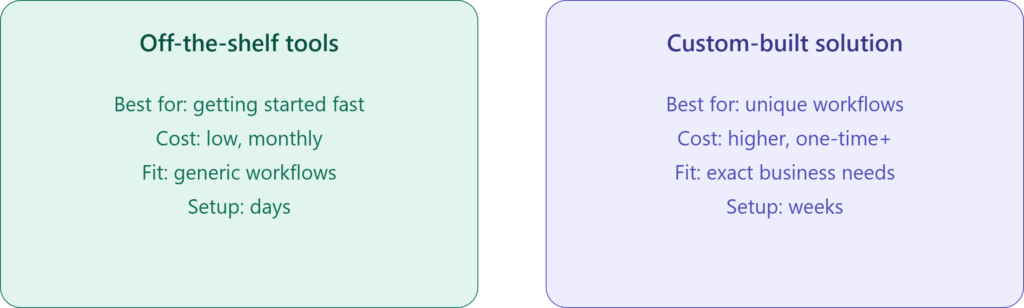
Most businesses start with off-the-shelf AI tools — chatbot platforms, writing assistants, scheduling tools. That’s the right move initially; it’s low-cost and low-risk while you learn what actually saves you time.
The limitation shows up once your business has specific workflows off-the-shelf tools weren’t built for — a booking system with unusual rules, a CRM that needs to talk to three other tools, or customer data that needs to stay within specific compliance boundaries (GDPR matters here for any UK business handling customer data through AI tools). At that point, a custom-built solution usually pays for itself by removing the workarounds you’ve been living with. Our custom software team can help you figure out exactly when that tipping point is worth crossing for your business.
Keeping It Secure as You Scale
As AI tools start touching more of your operations, where that data lives and how it’s protected becomes a bigger question — not a smaller one. This is where solid cloud infrastructure matters: proper data handling, backups, and access controls so that automating a workflow doesn’t quietly create a compliance risk.
A Simple Framework to Get Started
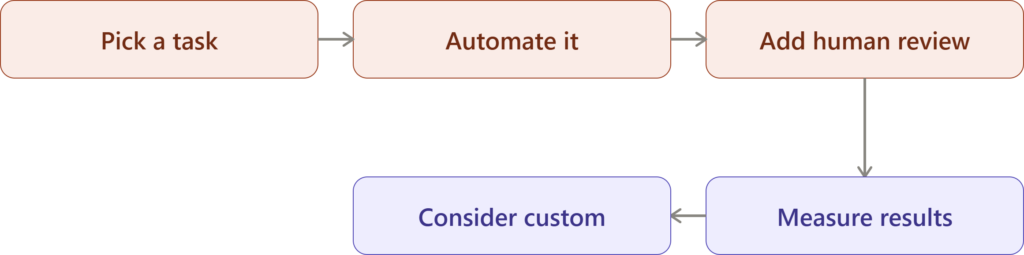
Here’s a simple framework for approaching AI for business development without overcomplicating it:
- Pick one repetitive task that eats real time — customer email replies, lead follow-up, or proposal drafts are usually the best starting points.
- Automate that one thing with an off-the-shelf tool before building anything custom.
- Keep a human review step for anything customer-facing or financially consequential.
- Measure the actual time saved before adding a second tool — five disconnected AI tools with no clear ROI is a common trap.
- Revisit build-vs-buy once you hit a workflow no off-the-shelf tool handles well.
Where to Start
The businesses seeing real results with AI for business development in 2026 aren’t the ones with the most AI tools. they’re the ones who automated one genuinely time-draining task properly, instead of experimenting with five things half-heartedly. If you want help identifying which task that is for your business, get in touch with our AI and automation team for a straightforward assessment.