
Hiring the wrong ecommerce web development company is expensive to fix, not just in cost, but in lost sales while you rebuild something that should have worked the first time. Here’s what actually matters when you’re evaluating a development company, and the questions worth asking before you sign anything.
Table of Contents
What an Ecommerce Web Development Company Should Actually Do
Building an online store isn’t just “make a website that sells things.” It involves product catalogue architecture, payment gateway integration, inventory management, checkout optimisation, and security compliance all of which need to work together without breaking under real customer traffic. A development partner who treats this like a standard brochure website is a warning sign.
What to Check Before You Hire
| What to Check | Why It Matters |
| Platform experience | Shopify, WooCommerce, and custom builds each suit different business sizes |
| Payment integration experience | Stripe, PayPal, and other gateways need to be set up securely |
| Portfolio of live stores | Ask to see real, working ecommerce sites, not just design mockups |
| Post-launch support | Ecommerce sites need ongoing updates, not a one-off handoff |
| Scalability | Can the site handle a traffic spike during a sale without going down? |
Platform vs Custom Build: What Fits Your Business
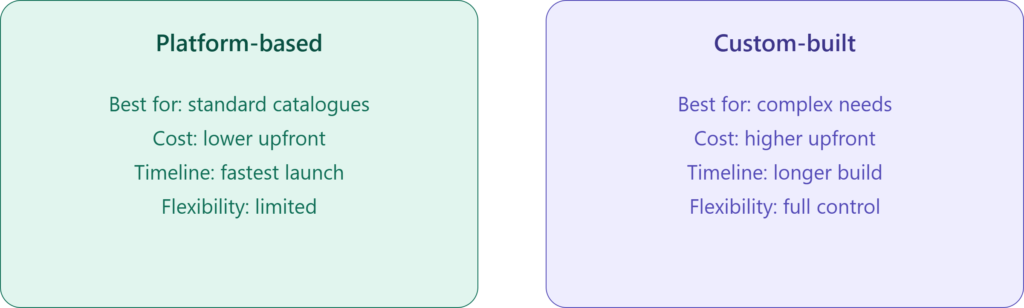
A good ecommerce web development company will tell you honestly which one fits your business:
- Platform-based (Shopify, WooCommerce) faster to launch, lower upfront cost, works well for standard product catalogues and typical checkout flows.
- Custom-built worth it when your business has specific requirements a platform can’t handle well: unusual product configurations, complex pricing rules, or integrations with existing business systems (inventory, CRM, accounting).
Questions to Ask Before You Commit
- Can I see a live store you’ve built, not just a design portfolio?
- How do you handle payment security and PCI compliance?
- What happens if the site goes down during a sale what’s your support response time?
- Do you build on a platform or custom and why would you recommend one for my business?
- What’s included after launch, and what costs extra?
If a company can’t answer these clearly, that’s worth noting before you sign anything.
Our Experience
As an ecommerce web development company, we’ve built platforms like WeBooks, a student textbook marketplace handling product listings, transactions, and user accounts at scale. Beyond ecommerce, our broader experience spans web and app development building platforms tailored to how a specific business actually operates, which is exactly the skill set an ecommerce build with any real complexity needs.
Common Questions About Ecommerce Web Development
How long does an ecommerce build typically take?
A platform-based build (Shopify or WooCommerce) usually takes 4-8 weeks depending on complexity. A custom build can take 3-6 months, since it involves more architecture, testing, and integration work. Any ecommerce web development company that promises a fully custom store in two weeks is cutting corners somewhere.
Do I need a custom build if I’m just starting out?
Not usually. Most businesses are better off launching on a platform first, proving the product and customer demand, then moving to a custom build once they hit limitations a platform can’t solve — unusual pricing rules, complex inventory logic, or integrations a platform doesn’t support well.
What should be included in ongoing support after launch?
At minimum: security updates, uptime monitoring, and a clear response time if something breaks during peak trading (like a sale or seasonal spike). If post-launch support isn’t clearly scoped before you sign, ask — it’s often where costs quietly appear later.
How do I know if a development company is right for my business?
Ask to see live stores they’ve built, not just design mockups, and check whether they ask about your business model before recommending a platform or custom build. A partner who recommends the same approach to every client regardless of business type is optimising for their convenience, not your outcome.
Get an Honest Assessment
If you’re planning an ecommerce site and want a straightforward view on whether a platform or custom build fits your business no push toward whichever’s more profitable for us get in touch with our team for a no-obligation conversation.